
What America Can Learn From Cultures That Never Stopped Talking to Each Other
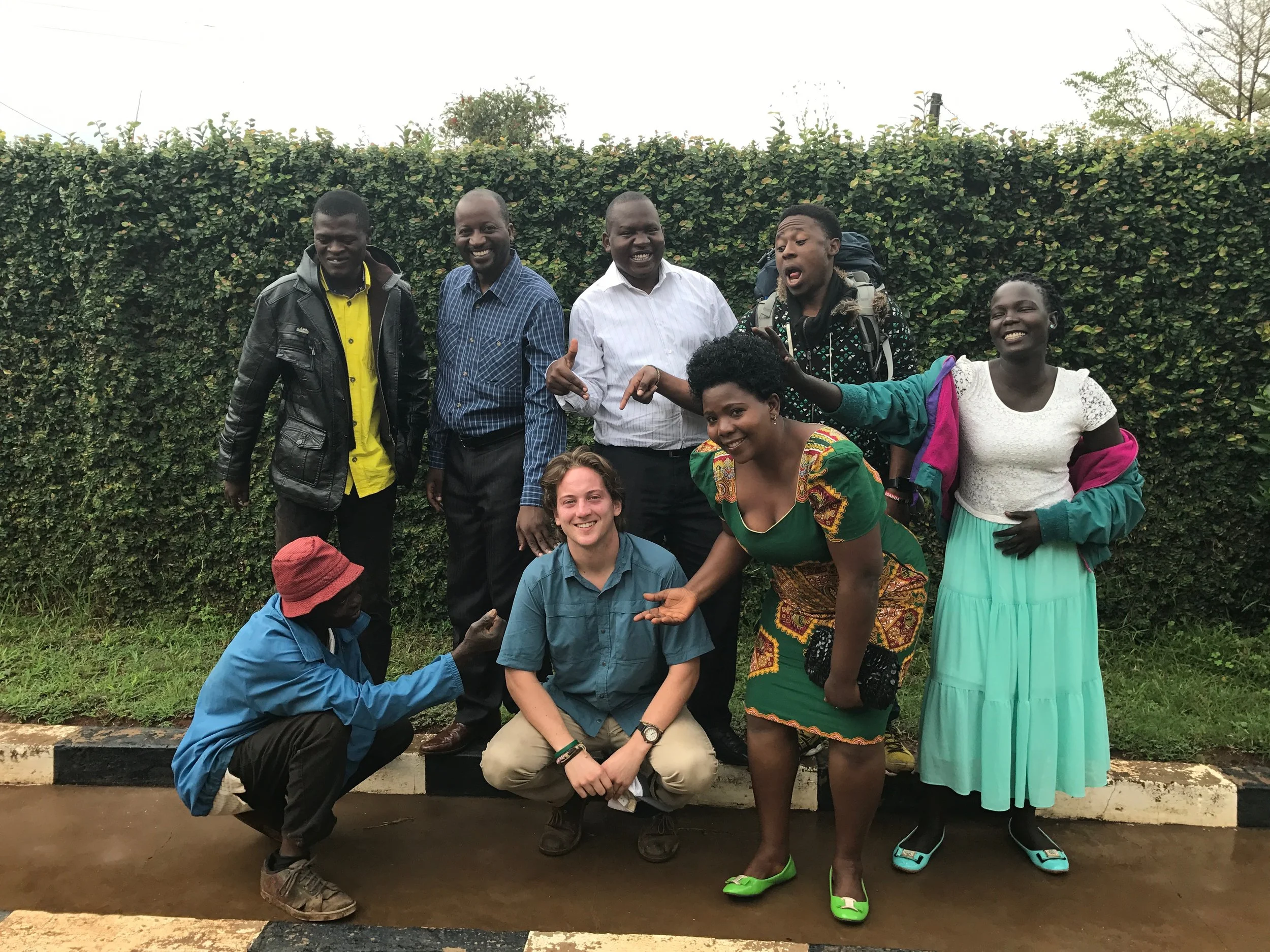
Tom Karrel squatting in the center of a group of his Ugandan colleagues from Uganda Village Project outside of their office in Iganga, Uganda of Summer 2017.
10 Minute Read
What if the modern loneliness epidemic isn’t simply the price of progress and technology, but the quiet consequence of cultural habits we chose to abandon?
It was a sweltering afternoon in Iganga District, a rural farming hub in Eastern Uganda. I was standing near the dusty gateway of one of the community health clinics where I was completing a summer public health internship.
A security guard I had passed dozens of times walked toward me. Instead of nodding politely or asking the standard American exchange—"How are you?" followed immediately by walking away before waiting for an answer—he stopped, looked me straight in the eye, and smiled.
"Ngobi!" he exclaimed, taking my hand in a warm, two-handed clasp. "Ngobi" was the local name from the Busoga kingdom given to me by village leaders during my first week. "You’ve been lost!"
I blinked, confused. I hadn't been lost. I just hadn't been by the center for a few days while my colleagues and I were away in Jinja for the weekend.
"You've been lost!" wasn't a geographical observation; it was a cultural acknowledgement. He was pointing out that my presence had been absent from the collective space. When I asked him to explain what it meant, he gave me a simple truth: We notice you. Your absence is felt. You belong here, and when you are not among us, the community is incomplete.
In that single moment, I realized how rarely I had ever felt that specific flavor of social accountability back home in Connecticut. In the United States, if you disappear into your house for three days, people assume you are respecting your own privacy. In rural Uganda, if you disappear for three days, people assume something is wrong—or at the very least, that you are missing out on the essential project of being human together. The community needs to check on you.
A Key Social Distinction
To understand why modern western societies are experiencing an unprecedented surge in isolation, we have to look at how different cultures construct their daily social environments.
Relational Norms = The unwritten rules governing how often, how deeply, and under what circumstances individuals interact with strangers and neighbors.
Social Friction = The degree of effort, social risk, or formality required to initiate a conversation with someone outside your immediate inner circle.
When we look at social dynamics globally, we find two distinct social operating systems:
COMMUNITY A: RELATIONAL DEFAULT
Interaction is expected whenever you see someone; public silence is rude
Strangers are treated as potential kin or neighbors
Shared space implies shared responsibility and conversation
Low social friction: greeting someone requires zero justification
COMMUNITY B: INDIVIDUALIST DEFAULT
Privacy is expected; interaction in public requires justification
Strangers are treated with polite, civil inattention
Shared space is partitioned through noise-canceling headphones & screens
High social friction: breaking silence feels risky or intrusive
Neither system was created maliciously, but they produce radically different public health outcomes.
What the Public Health Data Tell Us
According to the U.S. Surgeon General’s Advisory on Our Epidemic of Loneliness and Isolation, the lack of social connection carries a health risk equivalent to smoking up to 15 cigarettes a day.
1 in 4 adults worldwide report feeling profoundly lonely on a daily basis, with the highest rates concentrated in high-income, individualist nations. (Source: World Health Organization & Gallup Social Connection Index)
This statistic isn't just about emotional distress; it's a structural indicator of community health. We have built suburban environments and digital workflows that optimize for individual efficiency while systematically eliminating the exact micro-interactions that keep humans grounded and connected.
"We scroll for the exact reason we used to lean over the fence to talk to our neighbors: we want to feel like we belong somewhere."
What We Quietly Traded Away
Growing up in Connecticut, I lived in an environment where very few people struggled for basic material survival. The average income, access to infrastructure, and physical security were beyond what billions of people on Earth could conceptualize. In my young mind, I assumed this was the pinnacle of human development.
It took living and working in rural Uganda—a community designated in public health metrics as the "last mile" of delivery—to unravel my bias.
In Iganga, people lacked access to modern healthcare and social services, yet the social fabric was astonishingly dense. Neighbors shared livestock, land, and household goods without formal contracts. Time was dictated not by a clock, but by communal events—working in the garden, meals, burials, weddings, or tea on a porch. Each visit to a home began with an offering of a chair, tea, roasted groundnuts, fresh mangoes, and genuine curiosity.
If I approached a stranger in my suburban hometown, I was often met with polite caution. In Iganga, I was met with hospitality.
We didn't lose our tight-knit communities because Americans suddenly became cold or uncaring. We lost them because our systems changed:
Suburban Design: We traded walkable town squares and front porches for cul-de-sacs, attached garages, and privacy fences.
Erosion of Third Places: Coffee shops, community halls, and parks were replaced by drive-thrus, delivery apps, and subscription streaming.
Efficiency as a Virtue: We optimized every errand to require as little human contact as possible.
We achieved ultimate convenience—and accidentally manufactured an epidemic of social isolation.
From a Recent LARC Conversation
Recently, my partner Taylor and I stopped by a local market in Westport, Connecticut, to order fresh juices after a long summer travel stint. While waiting, a woman overheard us chatting and introduced herself.
Within three minutes, we discovered an uncanny overlap: she was currently living in my hometown of Westport, but had grown up in the exact neighborhood in Santa Barbara, California, where Taylor and I were planning to move that coming fall.
What started as a random interaction quickly turned into a multi-layered conversation. We didn't stick to weather or jobs. We talked about how adults make friends in new places, what makes a neighborhood feel safe enough to lower your guard, and why it feels so rare to have an unscripted moment with a stranger in 2026.
That conversation wasn't an accident. It happened because all three of us decided, for five minutes, to opt into Community A instead of Community B.
"The true measure of a community isn't found in real estate values or beach passes. It comes down to one question: If you disappeared for a month, how many people in town would notice?"
Being Human in a Digital World
As artificial intelligence automates routine communication and algorithms curate our attention, face-to-face interaction is becoming rare and precious.
When technology reduces our need to talk to clerks, drivers, or neighbors, we don't just gain speed—we lose the "conversational gym" that helps us practice building confidence, empathy, and social fluency. We forget how to read body language, navigate minor awkwardness, and stay curious about someone whose life experience differs from our own.
The goal isn't to reject technology or replicate rural Ugandan village life in suburban America. The goal is to realize that belonging is a practice, not a location.
"Culture and belonging aren’t an abstract force that happens to us. It is the accumulation of millions of micro-choices we make every single day."
Returning to the Question
So, is the loneliness epidemic inevitable? Or is it cultural?
It is cultural, which means we can change it.
When I returned to the United States after four years of working across Uganda, China, and Mexico, I realized that "development" is far more complex than economic indicators. A society can be materially wealthy and relationally bankrupt. Conversely, a community with scarce physical resources can possess an abundance of social capital that keeps every member anchored to the people around them.
We don't have to move across the world to find a village. We just have to start building one on the street where we live.
Conversation Challenge
TRY THIS TODAY: The next time you are waiting in line at a market, train station, or coffee shop, keep your phone in your pocket. Look around until you notice something genuinely interesting or curious about someone near you.
START WITH: "Excuse me, I couldn't help but notice... [insert genuine observation or compliment]. Would you tell me more about that?"
Note: Most people love a genuine opportunity to talk about themselves—especially regarding something they are wearing or something in their immediate surroundings.
Closing
We don't have to adopt or move into another culture completely to learn from it and improve our own. We only have to remember that every culture on Earth is built from ordinary, repeatable human habits. Look up, make eye contact, and risk going first. You never know who is waiting for permission to remind you that you belong.
Sources
U.S. Department of Health and Human Services (2023).Our Epidemic of Loneliness and Isolation: The U.S. Surgeon General’s Advisory on the Healing Effects of Social Connection and Community.
Putnam, Robert D. (2000).Bowling Alone: The Collapse and Revival of American Community. Simon & Schuster.
World Health Organization (2023).Commission on Social Connection (2024–2026). WHO Public Health Advisory.
Adichie, Chimamanda Ngozi (2009).The Danger of a Single Story. TED Conference.
Questions This Article Opens Up
How do we balance our need for personal privacy with the desire for a tighter-knit community? Privacy and community are not mutually exclusive; they are held in balance by clear social boundaries. The issue in modern western societies isn't that we value privacy, but that privacy has become our absolute default setting for every public space. Cultivating a relationally healthy culture doesn't mean giving up personal space or forcing deep personal disclosures with everyone you meet. It simply means lowering the barrier for basic, friendly acknowledgement. When we offer a simple greeting, a smile, or a brief question to a stranger or neighbor, we aren't invading their privacy—we are establishing a baseline of psychological safety that lets everyone know they are seen, safe, and welcome in the shared space.
Isn't it harder to build "village-style" trust in diverse, transient modern cities than in small villages? Yes, transience and extreme diversity increase what sociologists call "transactional friction." In small, homogeneous villages, shared norms and long histories create built-in trust. In modern suburban or urban environments, people move frequently and bring varied cultural expectations. However, this is precisely why spontaneous, low-stakes conversations are more critical in modern cities, not less. When we don't know our neighbors automatically, small positive micro-interactions become the only way we actively build social trust. Research on "weak ties" demonstrates that even brief, casual interactions with acquaintances and strangers significantly increase our overall sense of safety, civic trust, and emotional well-being.
What role does urban design play in restoring these conversational habits? Urban design acts as the invisible architect of human behavior. When neighborhoods are designed solely around cars, attached garages, and private backyards, spontaneous encounters drop to near zero. Conversely, environments featuring walkable sidewalks, public benches, mixed-use zoning, front porches, and central parks naturally invite chance meetings. While an individual may not be able to redesign their town's infrastructure overnight, we can choose to occupy the public spaces that do exist. Choosing to walk instead of drive for short errands, sitting on a front porch instead of a back patio, or visiting a local park regularly are micro-choices that put us back in the path of unexpected human connection.
How can introverts engage in "LARC" without feeling socially exhausted? A common misconception is that random conversations require boisterous, extroverted energy or long, deep discussions. In reality, effective relational habits are built on quiet curiosity and active listening—traits that introverts naturally possess. A meaningful interaction can last thirty seconds and consist entirely of asking a thoughtful question and truly paying attention to the answer. Introverts often excel at LARC because they prefer genuine, one-on-one connections over loud group dynamics. Reclaiming the art of conversation isn't about performing or being the center of attention; it's simply about demonstrating to another person that they have been noticed.
Continue the Conversation
Read Next
Why Is It So Hard To Talk To Strangers?
What Makes People Feel Like They Belong?
Why Are We More Connected Than Ever Yet Feel So Alone?
