
What Makes People Feel Like They Belong?
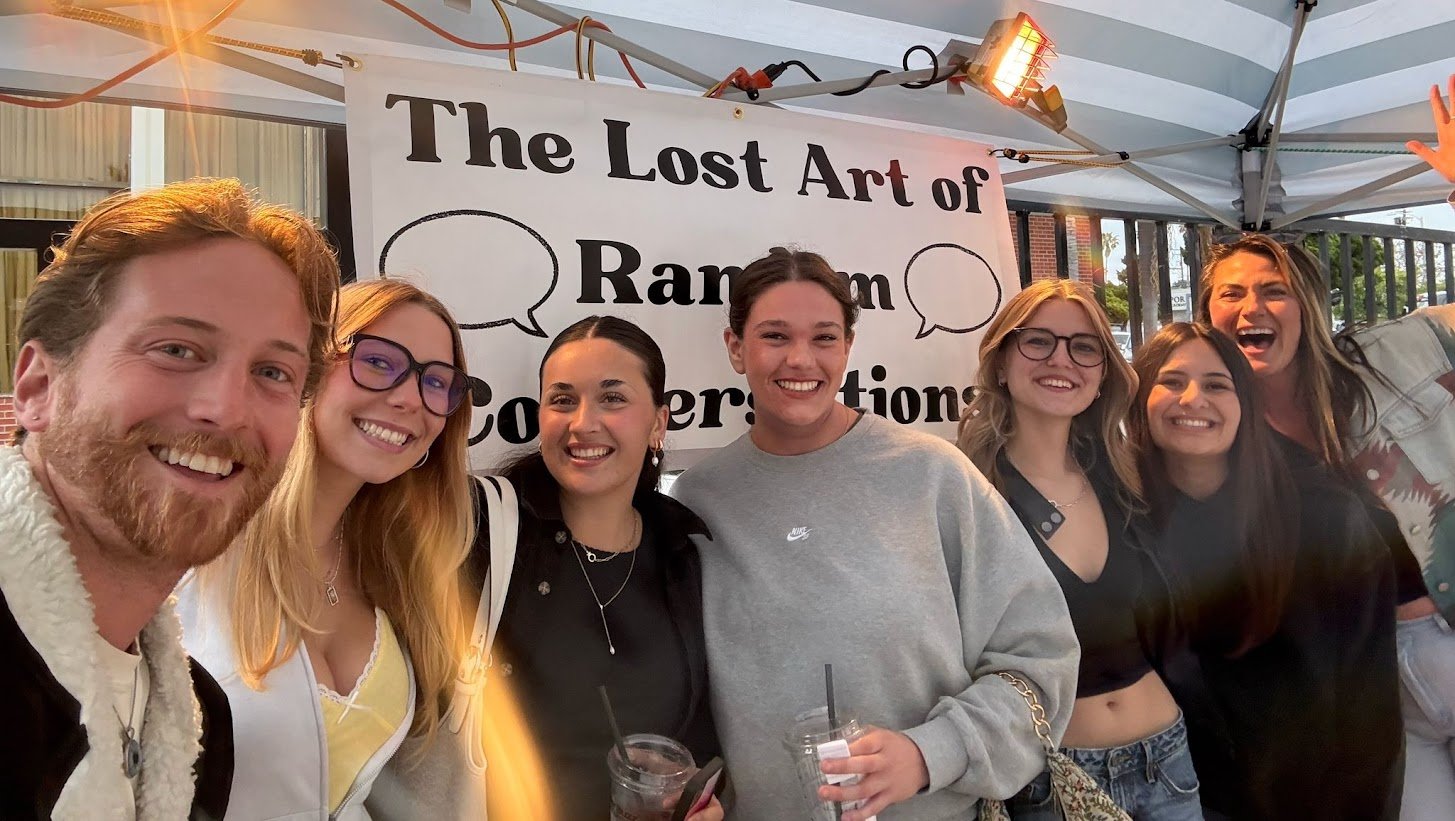
Group of strangers at a LARC pop-up event in Oceanside, CA with LARC co-founders Tom & Taylor
10 Minute Read
We all want to belong. But almost no one is taught how to create belonging.
Belonging isn’t something you stumble into. It’s something you build by being needed, known, and chosen again and again.
I lived in Uganda for five years in my 20s. Every time I returned to Kampala after being away for a while, one of my favorite greetings came from the security guard at my apartment complex:
“Tom, you’ve been lost!”
It was his way of saying two things at once: you’ve been gone, and you’ve been missed.
That’s what I’ve learned about belonging. You don’t stumble into it. You build it through action, repetition, and by being an active, present part of the community around you: by the willingness to go first. Belonging isn’t a place you find, but a feeling you create by being needed, being known, and showing up again and again — so that people notice when you’re gone.
Research backs this up. A stronger sense of belonging predicts a stronger sense of meaning in life, including across longitudinal and experimental studies.¹ A 2021 review describes belonging as a central human need shaped by specific opportunities, motivations, competencies, and perceptions — not just general good vibes.² And the World Health Organization now frames social connection as a public-health priority because loneliness and social isolation significantly affect the health and well-being of our society at scale.³,⁴
So if belonging is built, not found, how do we actually build it?
What is Belonging?
Belonging is the feeling of being happy or comfortable as part of a certain group. It’s the feeling where you are needed, known, accepted, and valued.
What Builds Belonging
You build belonging by being needed by those around you.
If I can be of service to someone else—taking care of a loved one, helping an elder load groceries into their car, or being the person someone calls for support— verything else fades away. At that moment, there’s no doubt that I matter.
That feeling is powerful because it doesn’t just say, “You are included.” It says, “You are useful, trusted, and needed here.”
When someone says, “Hey, will you help me with something?” I usually feel honored, not burdened. When someone checks in on me unprompted because they know I’m going through something hard, I feel supported by a real community. I feel like I belong.
So let’s stop apologizing for reaching out to friends, family, and colleagues. You are not a burden when you need help or want to hear someone’s voice. We’ve gotten so worried about bothering people that we start every call with “sorry,” or we stop calling altogether. Most people want to be reached out to far more than we think. Asking for help is not an imposition; it’s an invitation to tangibly matter to someone else.
You build belonging by being truly known by others.
Have you ever walked into a gathering, seen an old friend, and heard, “Hey, I’ve missed you!” and known they really meant it? That tells you that your absence was felt.
Remembering names does a similar thing. At LARC events, people are always surprised when I remember their names, as am I when they remember mine. That’s partly because most adults believe they’re terrible at it, so being remembered by name—or by a few specific things we shared last time—feels rare enough to mean our last conversation really mattered.
When we take the time to remember something about someone else, they usually remember us more too. Our interest in them becomes magnetic. It says, “I paid attention to you.” That can make people feel like they belong before they’ve even said much at all.
Belonging begins when someone notices you were missing.
Now, let me introduce you to someone called “the glue.”
The glue is the person who helps people cross the invisible, awkward gap between them; who gives each person enough sense of comfort and confidence to initiate a random conversation that may turn into a lasting friendship. The one who walks into a group and subtly stitches conversations together until suddenly a group of recent strangers is talking like old friends.
The world needs more glue. Not people who force agreement, but people who create enough comfort for genuine conversation to happen more often, especially with people who don’t already know each other. Are we each willing to ask a curious question? Take genuine interest in the other person’s life? Make a little eye contact? Help someone relax when they don’t quite have the confidence to break through some social anxiety or fear on their own?
You build belonging by showing up for other people, again and again.
I talk about belonging a lot with my mom, because we are both born wanderers. Maybe we’ll never find “our one place,” but I’ve noticed a pattern: once I have one or two meaningful connections in a town, something shifts. I start thinking, okay, I could be here for a while. This could be somewhere I belong.
It starts with simple habits, like a park you run at, a beach you keep returning to, or that restaurant with that greasy, perfect burrito you get after work on Fridays. Familiarity anchors us to a place and creates that first feeling of belonging.
Then it deepens through relationships. The person at the movie theater whose name you learn. The swimmer at the beach who gives you local event recommendations. The mail carrier you ask about their life, and the romance novel they’ve been writing. Consistent habits and developing relationships together start making somewhere feel like yours.
Someone calling out of the blue. Someone showing up uninvited. Someone bringing a handmade gift, writing a thoughtful note, or actually following through on a plan. In a world where everyone seems to be too busy, genuine effort to make someone else feel valued or included is one of the clearest signals that someone matters to you.
But this has to be reciprocal over time, or it fades. Or worse, it starts to build resentment. Belonging requires that both people keep stoking the fire. A lot of us form an initial connection and then let the flame die because neither of us was willing to keep going. We end up in non-friendships where we keep saying “we should hang out soon!” but never actually do it.
“The world needs more glue.”
So if I want belonging, I have to go first.
If I want people to listen more, I need to listen more first. If I want better friends, I need to be a better friend. If I want trust and emotional availability from others, I need to model it first.
If we’re not feeling belonging, we have to ask honestly: what am I doing, or not doing, to create the conditions I want?
Being Human in a Changing World
A big reason it can feel hard to initiate random conversations is that we don’t know if people actually want to talk to us. We see headphones, screens, busy faces, and our mind starts making up reasons to stay safe. They’re not interested. I’ll say the wrong thing. It’ll be awkward.
That’s a very modern problem. We live in a world that makes it easier than ever to communicate without actually connecting. Screens, schedules, and constant busyness can make real presence feel optional, when it’s actually the thing people are craving most.
Conversation Challenge
So your LARC practice today is simple: acknowledge that fear of going first—of initiating a conversation, complimenting someone, or asking if they need help—and do it anyway. Because most of the time, the fear is bigger in your head than it is in the moment. And that conversation or action, however small it seems, could help you and that other person feel more like you belong today.
You build belonging by being needed. By being known. By showing up again and again.
Because underneath this whole pursuit is one simple question: would anyone notice if I disappeared?
You build belonging by being needed. By being known. By showing up again. And it starts the moment you’re willing to go first.
Sources
Lambert, N. M., Stillman, T. F., Hicks, J. A., Kamble, S., Baumeister, R. F., & Fincham, F. D. (2013). To belong is to matter: Sense of belonging enhances meaning in life. Personality and Social Psychology Bulletin, 39(11), 1418–1427. https://pubmed.ncbi.nlm.nih.gov/23950557/
Allen, K.-A., Kern, M. L., Vella-Brodrick, D., Hattie, J., & Waters, L. (2021). Belonging: A review of conceptual issues, an integrative framework, and directions for future research. Australian Psychologist, 56(4), 287–303. https://www.tandfonline.com/doi/full/10.1080/00049530.2021.1883409
World Health Organization. (2025, June 29). Social connection linked to improved health and reduced risk of early death. https://www.who.int/news/item/30-06-2025-social-connection-linked-to-improved-heath-and-reduced-risk-of-early-death
World Health Organization. (2025). From loneliness to social connection: Charting a path to healthier societies: Report of the WHO Commission on Social Connection. https://iris.who.int/handle/10665/381746
